
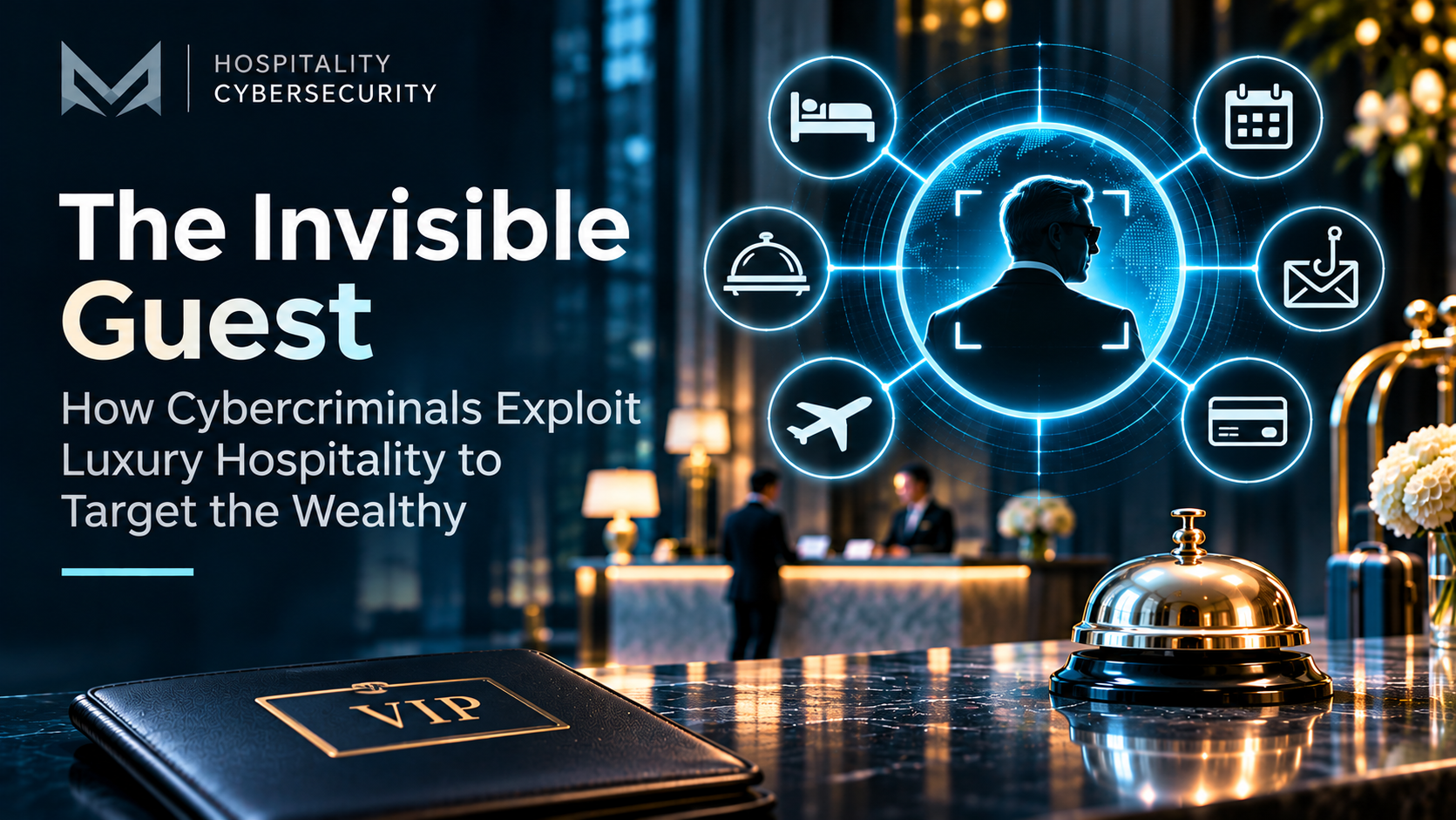
For high-net-worth individuals, privacy is more than a luxury. From exposed travel itineraries and compromised concierge communications to targeted social engineering, the digital information surrounding a hotel stay can create security risks that extend far beyond the property itself.
Luxury hospitality is built around personalisation.
A returning guest may find their preferred suite prepared before arrival, their favourite restaurant reserved, and a private vehicle waiting at the airport. Their dietary preferences, preferred amenities, and personal requirements may already be known to the establishment.
For wealthy and high-profile individuals, this level of service is often an expectation rather than an exception.
Behind these seamless experiences, however, exists an extensive network of digital information.
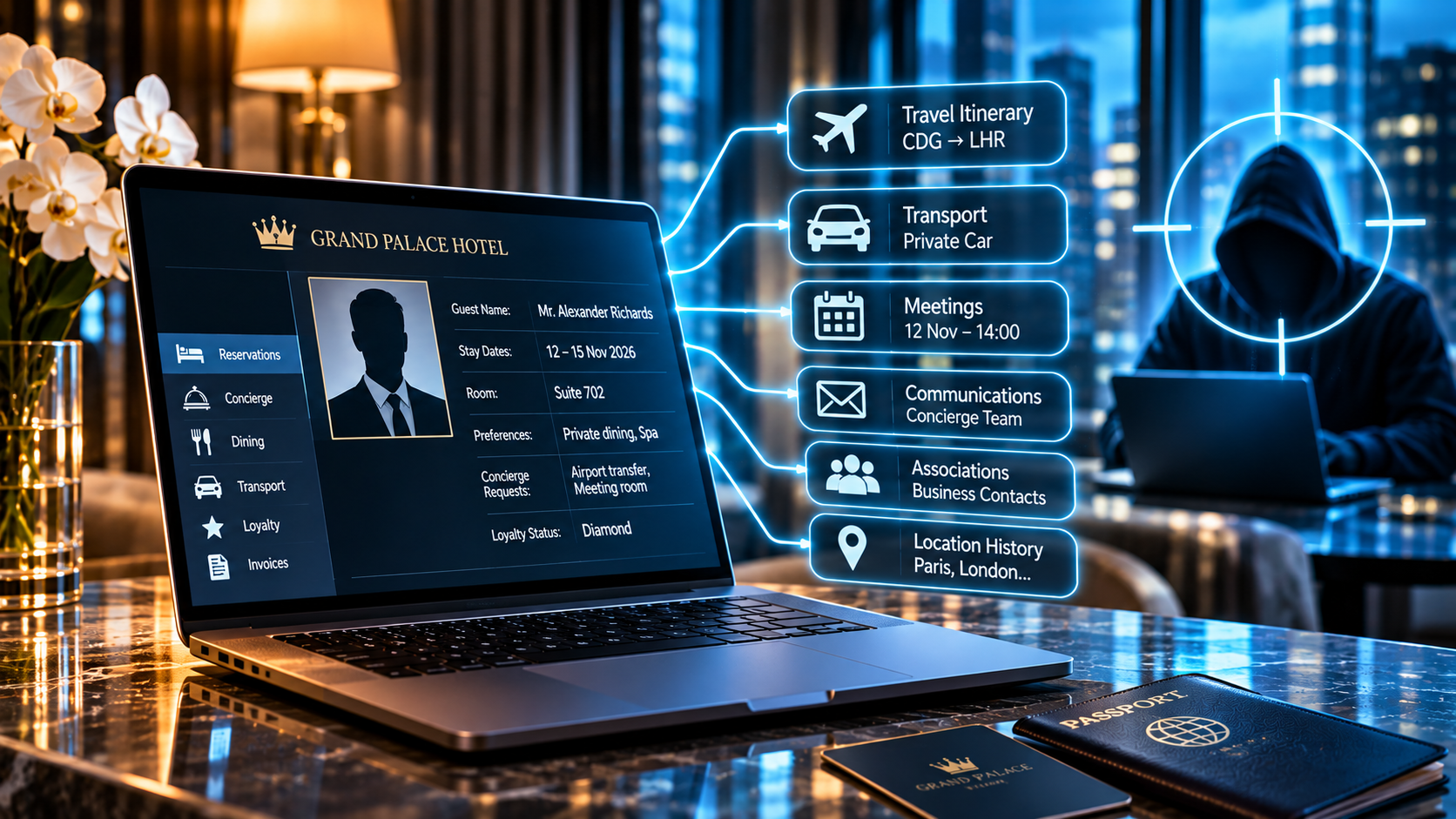
Reservation platforms communicate with property management systems. Concierge teams coordinate with transport companies, private aviation operators, restaurants, and personal assistants. Guest preferences are recorded in customer relationship management databases, while invoices and itineraries circulate between multiple organisations.
Each interaction contributes to an increasingly detailed picture of the individual.
For an attacker, the objective may not be to steal money directly from a hotel. It may be to exploit the hotel as a source of information or a trusted communication channel to reach a much more valuable target.
Understanding this distinction is essential for luxury hospitality operators, family offices, executive protection professionals, and anyone responsible for safeguarding high-net-worth individuals (HNWIs).
1. The Digital Footprint of a High-Net-Worth Guest
Most people associate their digital footprint with social media, internet browsing, and publicly available information.
For wealthy individuals, however, an equally important footprint may exist within the organisations providing their everyday services.
A single international trip can generate records across numerous businesses.
These may include:
Luxury hotels: Reservations, room preferences, guest profiles, and billing information.
Private aviation and transport providers: Arrival times, transfer arrangements, and passenger details.
Concierge services: Restaurant bookings, personal appointments, and special requests.
Private dining and event operators: Guest lists, dietary requirements, and event locations.
Personal assistants and family offices: Itineraries, invoices, and confidential correspondence.
Third-party booking platforms: Reservation confirmations, contact information, and travel histories.
Individually, these records may seem relatively insignificant.
Collectively, they can reveal a considerable amount about someone's movements, relationships, habits, and personal circumstances.
In intelligence analysis, this process is known as information aggregation.
The security implications become particularly important when data from different sources can be correlated.
For example, a hotel reservation might establish that an executive is visiting a particular city.
A restaurant booking could suggest a potential meeting. A transport arrangement may reveal an intended destination, while a publicly announced corporate event could provide context for the visit.
None of these details necessarily reveals confidential information on its own.
Together, however, they may enable an attacker to develop a more accurate profile of the individual.
From information to intelligence
Cybersecurity professionals frequently distinguish between raw data and actionable intelligence.
Raw data consists of individual facts or records.
Intelligence emerges when those records are analysed, correlated, and placed into context.
For high-profile individuals, this distinction matters because seemingly routine hospitality information can acquire additional sensitivity when combined with other sources.
An attacker may use publicly available information, commonly referred to as open-source intelligence (OSINT), alongside unlawfully obtained data to identify potential opportunities.
OSINT itself is not inherently malicious. It is routinely used by legitimate security professionals, journalists, researchers, and investigators.
The risk arises when information is collected or exploited for fraud, harassment, surveillance, or other unauthorised purposes.
2. When the Hotel Becomes an Indirect Attack Vector
A sophisticated attacker does not always need to compromise the intended victim directly.
In some circumstances, targeting a less protected organisation within the victim's network of relationships may provide an easier opportunity.
This is particularly relevant to luxury hospitality.
A high-net-worth individual may employ professional cybersecurity advisers, use managed devices, and maintain strong authentication controls.
Yet their personal information may also be held by hotels, travel agencies, concierge companies, and smaller service providers operating with very different levels of security maturity.
These external organisations form part of the individual's broader digital exposure.
Understanding third-party compromise
Consider a hypothetical scenario.
An attacker obtains unauthorised access to a luxury concierge company's email account.
The compromised account contains correspondence with a family office arranging accommodation, private transport, and restaurant reservations.
Rather than attempting to penetrate the family office's own systems, the attacker may exploit the existing trusted relationship.
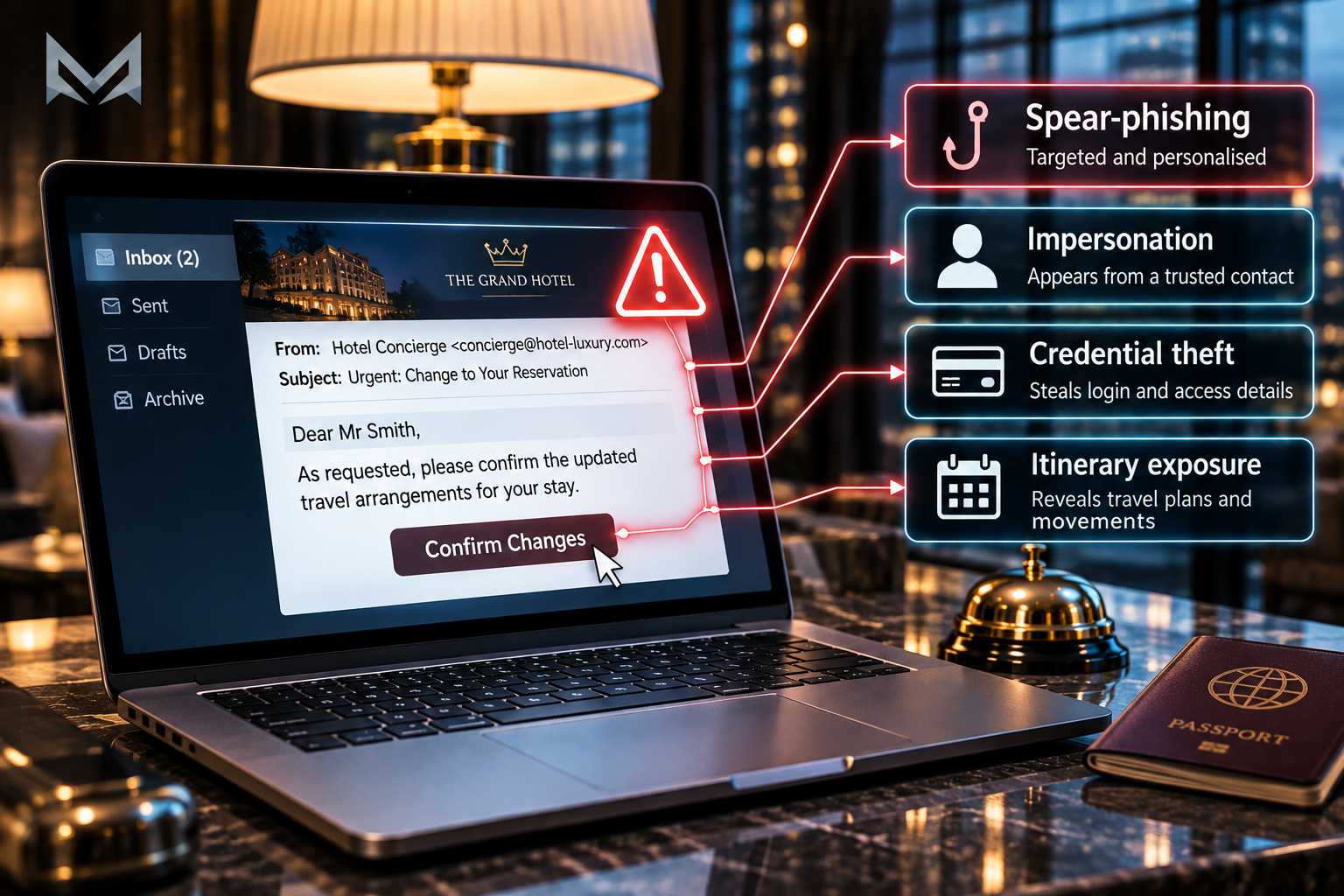
A fraudulent message appearing to originate from the concierge could request an itinerary change, introduce a malicious document, or provide altered payment instructions.
This is closely related to business email compromise (BEC), a category of fraud in which attackers misuse trusted business communications to manipulate recipients.
The attack may succeed without deploying sophisticated malware.
Its effectiveness depends on the credibility of the sender, the timing of the communication, and the recipient's willingness to act on what appears to be a legitimate request.
Why hospitality is particularly exposed
Hospitality professionals are expected to be responsive, accommodating, and discreet.
An urgent request from a personal assistant or VIP guest may receive immediate attention.
Unfortunately, these same operational characteristics can be exploited through social engineering.
The solution is not to make hospitality staff suspicious of every guest.
It is to introduce reliable verification procedures for requests involving sensitive information, financial transactions, or unusual changes to established arrangements.
3. Spear-Phishing: Attacks Built Around the Individual
Most hospitality operators are familiar with conventional phishing.
An employee receives an email impersonating a bank, booking platform, or technology provider and is encouraged to disclose credentials or open a malicious link.
Spear-phishing is more targeted.
Rather than distributing identical messages to thousands of recipients, an attacker uses information about a particular individual or organisation to construct a more convincing communication.
For high-net-worth guests, hospitality records can provide useful context.
An attacker who knows that an individual is staying at a particular hotel may be able to construct a message that appears relevant to their immediate circumstances.
For example, a fraudulent email could impersonate a hotel reservations team and refer to an existing booking.
The message might request verification of payment information or direct the recipient to a counterfeit guest portal.
The technical mechanisms may be relatively ordinary.
The sophistication lies in the personalisation.
The technical components
Targeted phishing campaigns may involve several techniques:
Email spoofing: Manipulating the apparent sender identity, although modern email authentication controls can make some forms of spoofing more difficult.
Lookalike domains: Registering domains that resemble legitimate hospitality or travel providers.
Credential harvesting: Directing victims to fraudulent authentication pages.
Adversary-in-the-middle phishing: Using malicious authentication infrastructure to intercept certain login sessions or authentication tokens.
Session hijacking: Attempting to misuse stolen session tokens or other authentication material to access an account.
These techniques vary in complexity and effectiveness.
Properly implemented phishing-resistant authentication, such as FIDO2 security keys or passkeys, provides stronger protection against credential phishing than passwords or conventional one-time codes alone.
However, authentication security should be combined with domain verification, secure communications, and effective incident reporting.
Protecting the trusted relationship
Hotels and concierge providers should establish clear procedures for communicating sensitive requests.
For example, changes to payment details or confidential travel arrangements should be verified through a previously established, trusted communication channel.
A telephone number supplied within a suspicious email should not automatically be considered a reliable verification method.
The central principle is straightforward:
Trust in an established business relationship should not automatically extend to every message that appears to originate from that relationship.
4. Executive Travel: When Digital Exposure Creates Physical Risk
For high-profile individuals, the consequences of a data breach may extend beyond financial loss or reputational damage.
Travel information can have direct implications for personal security.
A compromised itinerary may reveal arrival and departure times, accommodation arrangements, or planned movements.
This information could potentially be exploited by individuals seeking to track, approach, harass, or otherwise target a guest.
The likelihood of such activity varies considerably according to the individual's public profile, circumstances, and threat environment.
Nevertheless, the connection between digital information and physical security is an important consideration.
Cybersecurity and executive protection
Traditional executive protection focuses heavily on physical security.
This may include secure transport, access control, route planning, and coordination with venues.
Modern protective security increasingly requires consideration of digital exposure as well.
For example, an executive protection team may maintain carefully controlled travel arrangements while an external service provider stores the same itinerary in a broadly accessible cloud application.
The physical security plan may be sound, but the information supporting it could still be exposed.
This creates a gap between physical and digital protection.
Practical safeguards
Hotels and associated service providers should consider:
Restricting access to sensitive itineraries and transport arrangements.
Avoiding unnecessary distribution of guest movement information.
Using approved, appropriately secured communication channels.
Establishing clear procedures for verifying changes to travel arrangements.
Reviewing how long sensitive travel records are retained.
Coordinating confidentiality requirements with authorised executive protection personnel.
For particularly sensitive guests, information may be distributed on a need-to-know basis.
This does not mean withholding essential operational information from staff.
It means ensuring that employees receive the information necessary to perform their duties without unrestricted access to unrelated details.
5. The Family Office: A High-Value Target Beyond the Hotel
Family offices occupy an important position within the security environment of wealthy individuals.
They may coordinate financial affairs, property management, travel, household staffing, and relationships with numerous external service providers.
A family office can therefore become a central point through which sensitive personal and operational information passes.
The security challenges are not limited to large, formally structured organisations.
A smaller arrangement involving a personal assistant, accountant, estate manager, and several external suppliers may handle similarly sensitive information.
The extended attack surface
In cybersecurity, the attack surface describes the collection of systems, identities, services, and interfaces that could potentially be exploited.
For a high-net-worth individual, this surface extends beyond personally owned devices.
It may include:
Family office email and document-sharing platforms.
External accountants and legal advisers.
Household management applications.
Travel and concierge providers.
Property management and smart-building systems.
Hospitality businesses retaining guest information.
The difficulty is that these systems are rarely managed under a single security policy.
Different providers may use different authentication standards, retention periods, and access controls.
This fragmentation can create inconsistencies.
Vendor risk management
A practical response is to establish a proportionate third-party risk management process.
This may involve identifying which suppliers handle sensitive information, understanding how they protect it, and defining appropriate security expectations.
For hospitality providers serving family offices, demonstrating effective security controls can become a competitive advantage.
A luxury hotel that can explain its access controls, confidentiality procedures, and incident response arrangements may provide greater reassurance than one relying solely on traditional promises of discretion.
6. The Insider Threat: When Personalisation Creates Excessive Access
Luxury hospitality relies on employees understanding guest preferences.
A concierge may know a guest's preferred restaurants, while reception staff may have access to reservation histories and special requirements.
This information helps create exceptional service.
However, the same information can become a security liability if access is poorly controlled.
Legitimate access versus necessary access
An employee may have a valid account within a property management system without needing unrestricted access to every guest record.
This distinction is central to the principle of least privilege.
Least privilege requires users and systems to receive only the permissions necessary to perform authorised tasks.
A well-designed access control system should therefore distinguish between operational responsibilities.
For example:
Employee roleAppropriate accessReceptionCurrent reservations and relevant check-in informationConciergeAuthorised service requests and necessary guest preferencesRestaurant managementDining reservations and relevant dietary requirementsFinanceBilling records and authorised financial informationIT administrationSystem administration functions, with sensitive data access restricted where feasible
This can be implemented through role-based access control (RBAC), supported by additional restrictions for particularly sensitive records.
However, permissions alone are insufficient.
Hotels should also monitor access to confidential information.
An employee repeatedly viewing unrelated VIP profiles, exporting unusually large datasets, or accessing records outside normal responsibilities may warrant investigation.
Such monitoring should be proportionate, properly authorised, and consistent with applicable employment and privacy laws.
The importance of audit trails
An audit trail records relevant activity within a system.
For sensitive hospitality applications, useful events may include:
Successful and failed authentication attempts.
Access to restricted guest records.
Changes to user permissions.
Bulk data exports.
Administrative configuration changes.
These records support accountability and incident investigation.
They also help organisations identify weaknesses before those weaknesses develop into serious incidents.
7. The Role of APIs and Cloud Integrations
Modern luxury hospitality depends on systems communicating automatically.
A guest reservation may trigger updates in the PMS, CRM, concierge platform, and other connected applications.
This communication frequently occurs through application programming interfaces (APIs).
APIs allow software systems to exchange information in a structured manner.
They are essential to modern digital operations, but poorly secured integrations can create vulnerabilities.
Broken object-level authorisation
One important API security weakness is broken object-level authorisation (BOLA).
This occurs when an application fails to verify that a user is authorised to access a particular object or record.
For example, an API may correctly authenticate a user but fail to enforce permissions on individual guest records.
An attacker exploiting this weakness could potentially access information beyond their authorised scope.
Other concerns include excessive API permissions, exposed credentials, insufficient logging, and insecure third-party integrations.
Defensive measures
Hospitality technology providers should implement:
Object-level authorisation: Every request for sensitive information must be checked against the requesting user's permissions.
Scoped API credentials: Integrations should receive only the permissions required for their intended functions.
Secrets management: API keys and other credentials should be stored securely, rotated when necessary, and excluded from publicly accessible code or configuration.
Logging and monitoring: Unusual requests, excessive data retrieval, and suspicious authentication activity should be investigated.
Data minimisation: Systems should exchange only the information required for a legitimate business purpose.
For hotel operators, these technical controls may be implemented primarily by software vendors.
Nevertheless, operators remain responsible for understanding the security implications of the systems and suppliers they select.
8. Building a Protective Security Strategy for High-Net-Worth Guests
Protecting wealthy and high-profile guests requires a coordinated approach.
Cybersecurity, privacy, operational procedures, and physical security should not be treated as completely separate disciplines.
A useful starting point is a structured assessment of the information collected throughout the guest journey.
Security areaKey assessment questionGuest profilingWhat sensitive information is collected, and why is it necessary?Access managementWhich employees and suppliers can access VIP records?CommunicationsHow are confidential requests and itinerary changes verified?Third-party securityWhich external providers receive guest information?Technical infrastructureAre PMS, CRM, APIs, and networks appropriately secured?MonitoringCan unusual access or large-scale data extraction be detected?Incident responseHow would the organisation respond to exposure of a sensitive guest's information?
For organisations with more mature security programmes, these assessments can be aligned with established frameworks.
The NIST Cybersecurity Framework 2.0 provides a structured approach to governing, identifying, protecting, detecting, responding to, and recovering from cybersecurity risks.
The MITRE ATT&CK framework can support more technical assessments by describing tactics and techniques used during cyber intrusions.
For example, a security team might examine whether compromised employee credentials could enable access to guest profiles, whether excessive data retrieval would generate alerts, and whether the organisation could contain a compromised third-party account.
The purpose is to identify realistic attack paths and introduce appropriate controls.
Incident response and confidentiality
A suspected breach involving a high-profile guest requires careful handling.
The organisation must preserve relevant evidence, contain unauthorised access, assess the information potentially exposed, and meet applicable legal obligations.
Where appropriate, it may also need to coordinate with the guest's authorised representatives or security team.
Discretion is important, but it must not interfere with mandatory breach notification requirements or legitimate investigations.
A well-prepared incident response plan should define these responsibilities before an incident occurs.
Conclusion: The Most Valuable Target May Not Be the Hotel
For luxury hospitality businesses, cybersecurity is often discussed in terms of payment security, ransomware, and protection of internal systems.
These remain essential priorities.
However, the presence of wealthy and influential guests introduces an additional consideration.
The hotel itself may not be the ultimate target. It may simply hold information that provides an opportunity to target someone else.
Reservation histories, concierge communications, travel arrangements, and guest preferences can become sensitive when collected, correlated, or accessed without authorisation.
For high-net-worth individuals, the consequences may extend from financial fraud to targeted social engineering, loss of privacy, reputational harm, or personal security concerns.
Protecting against these risks does not require treating every guest as a potential intelligence target.
It requires understanding how information moves through the hospitality environment, restricting unnecessary access, and ensuring that trusted relationships are supported by effective technical and operational controls.
Luxury hospitality has always promised privacy, discretion, and exceptional personal service.
In an interconnected world, delivering that promise increasingly depends on the security of the digital infrastructure operating behind the scenes.
The highest standard of hospitality is not simply knowing everything about a guest. It is knowing how to protect what has been entrusted to you.
Technical references and further reading
NIST Cybersecurity Framework 2.0 — Cybersecurity risk management
NIST SP 800-207 — Zero Trust Architecture
MITRE ATT&CK — Enterprise attack tactics and techniques
OWASP API Security Top 10 (2023) — API authorisation and access control vulnerabilities
CISA — Business Email Compromise and phishing guidance
US National Counterintelligence and Security Center — Travel security guidance
European Union — General Data Protection Regulation (GDPR)