
Luxury hotels have always been places where influential individuals meet, conduct business, and expect discretion. But in an increasingly connected world, the information collected to deliver exceptional hospitality can also become a valuable intelligence asset.
A five-star hotel is considerably more than a place to sleep.
It is an environment where senior executives, diplomats, wealthy individuals, government officials, and other influential guests frequently conduct both professional and personal activities.
Business negotiations take place in private suites. Confidential conversations occur over dinner. Corporate executives attend international conferences, while high-profile individuals rely on concierge teams to coordinate transport, appointments, and personal arrangements.
Much of this activity depends on information being collected, stored, and communicated between hotel departments.
Traditionally, protecting guest confidentiality was primarily a matter of professional discretion and physical security.
Today, that responsibility extends into an increasingly complex digital environment.
For certain guests, a hotel reservation may reveal more useful intelligence than the contents of an individual email.
Understanding this risk requires looking beyond conventional cybercrime and considering how hospitality infrastructure might be exploited for surveillance, intelligence gathering, and targeted information collection.
1. Why Luxury Hotels Are Attractive Intelligence Environments
The intelligence value of a luxury hotel does not necessarily come from its technology.
It comes from the people who use it.
A prestigious hotel in London, Geneva, Paris, Singapore, or another major international business centre may regularly accommodate individuals with access to commercially sensitive information, substantial financial resources, or confidential government activities.
Their presence can create opportunities for several different types of threat actors.
These may include:
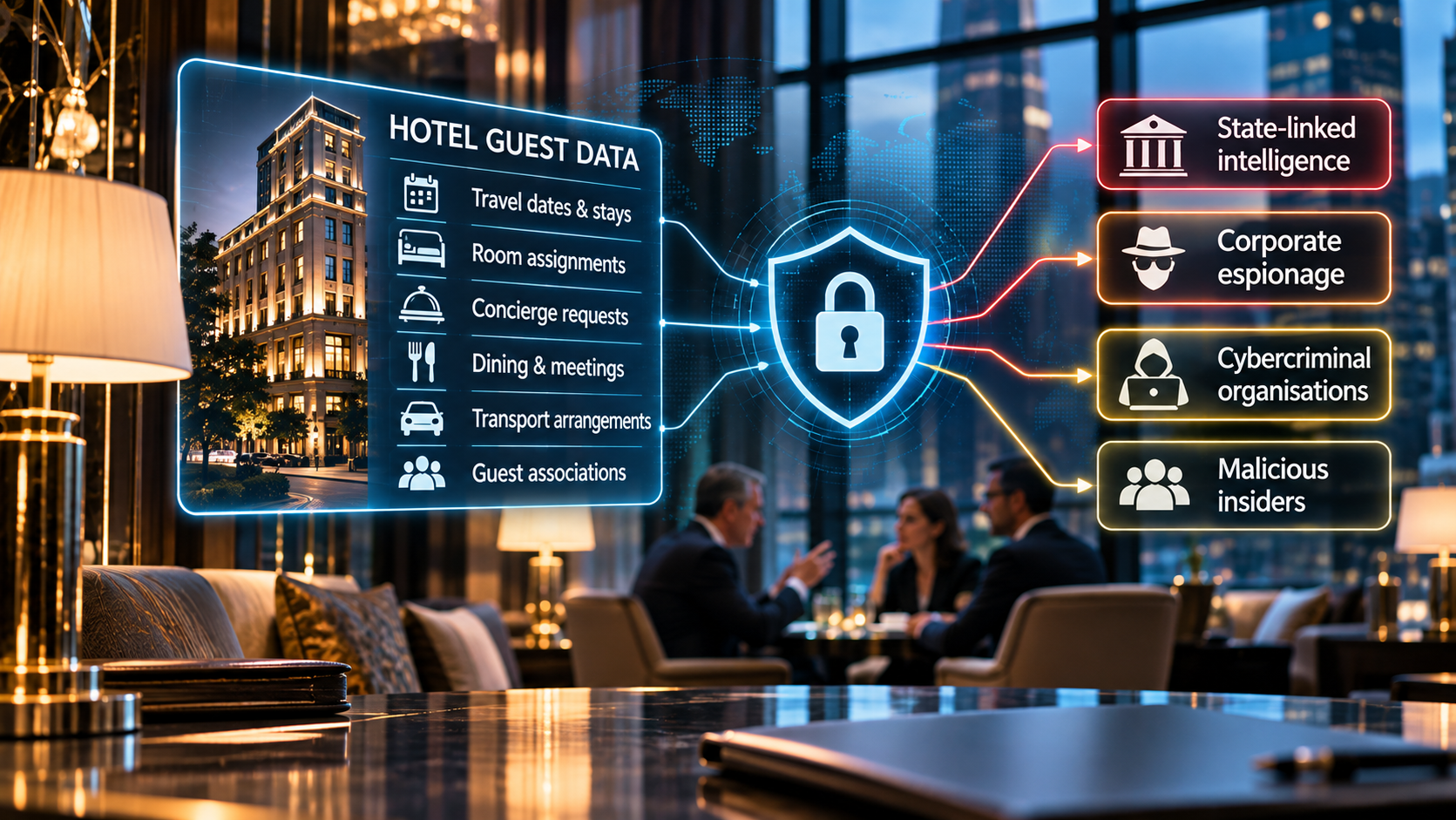
Cybercriminal organisations: Seeking financial information, personal data, or opportunities for fraud and extortion.
Corporate intelligence collectors: Attempting to obtain commercially sensitive information or details about business negotiations.
State-linked intelligence actors: Potentially interested in diplomatic activities, political relationships, or strategically important industries.
Malicious insiders: Individuals exploiting legitimate access to guest records or operational systems.
Stalkers and other targeted offenders: Seeking information about an individual's location, movements, or personal arrangements.
These threats should not be treated as equally likely.
Most hotels are considerably more likely to encounter ordinary cybercrime, credential theft, or payment fraud than a sophisticated intelligence operation.
However, the potential consequences change when a property regularly accommodates high-profile or security-sensitive guests.
In cybersecurity, this distinction forms part of threat modelling: identifying who might target an organisation, what they want, and which capabilities they could realistically employ.
A small independent hotel and a luxury property hosting an international diplomatic delegation may operate similar reservation software, but their threat profiles can be very different.
2. The Intelligence Value of Hotel Guest Information
A modern hotel collects information throughout the guest journey.
This often begins before arrival, through booking platforms, travel agents, personal assistants, or corporate travel departments.
The information may then be distributed across reservation systems, concierge applications, restaurant bookings, transport providers, and customer relationship management platforms.
Individually, these records may appear relatively harmless.
Collectively, they can reveal detailed patterns.
Consider the following information:
Reservation dates
Establishing travel schedules and anticipated presence
Room assignments
Identifying accommodation locations within a property
Concierge requests
Revealing activities, appointments, and personal preferences
Restaurant reservations
Identifying potential meetings or associations
Transport arrangements
Understanding planned movements and destinations
Loyalty and CRM records
Identifying repeat visits and behavioural patterns
This is an example of information aggregation.
The security risk emerges when multiple pieces of seemingly routine operational data are combined to create a more sensitive picture of an individual.
For example, knowing that a corporate executive is staying at a hotel may be of limited significance.
Knowing their arrival time, meeting arrangements, accompanying personnel, and departure schedule could be considerably more valuable.
The implications extend beyond privacy.
In some circumstances, such information could facilitate targeted phishing, commercial intelligence gathering, harassment, or physical security threats.
The technical challenge
Hotels frequently distribute guest information across multiple applications through application programming interfaces (APIs).
These integrations allow different systems to exchange information automatically.
For example, a PMS may share relevant guest information with a concierge platform or customer relationship management system.
An improperly secured API could potentially expose information through weaknesses such as broken object-level authorisation (BOLA), excessive data exposure, or inadequate authentication.
Broken object-level authorisation occurs when an application fails to verify that a user is permitted to access a particular record.
In a vulnerable system, an authenticated user might be able to request information belonging to another guest or account.
This is why API security must involve more than protecting login credentials.
Every request for sensitive information should be subject to appropriate authorisation checks, with access restricted to the specific records and functions required.
3. Hotel Networks: Convenience Versus Confidentiality
Reliable connectivity is now an essential component of luxury hospitality.
Guests expect high-speed Wi-Fi, connected televisions, digital concierge services, and seamless integration between personal devices and hotel technology.
These conveniences introduce additional cybersecurity considerations.
Hotel networks may support thousands of devices, including guest laptops, mobile phones, staff workstations, payment terminals, surveillance equipment, and building management systems.
The critical question is how effectively these environments are separated.
The risk of shared infrastructure
Consider a hypothetical hotel where guest devices and administrative systems are connected through inadequately segmented network infrastructure.
An attacker who compromises a vulnerable device may attempt to discover other systems, identify exposed services, or exploit weaknesses in network access controls.
This activity is commonly known as lateral movement.
In a properly designed environment, guest connectivity should not provide unrestricted access to internal hotel infrastructure.
Network segmentation, firewall policies, and access control mechanisms should restrict communications between unrelated systems.
For security-sensitive guests, the concern also extends to their own devices and communications.
Public and hotel networks should generally be treated as untrusted environments.
An attacker controlling a malicious wireless access point, for example, might attempt to redirect users to fraudulent authentication pages or interfere with insecure connections.
Modern HTTPS and correctly configured end-to-end encryption substantially reduce the ability of a network operator or attacker to read protected communications.
Nevertheless, risks remain from phishing, malicious captive portals, compromised devices, and insecure applications.
Practical protection
Hotels should maintain properly isolated guest networks, secure wireless configurations, and restricted access to network administration.
High-risk travellers should consider using trusted connectivity, updated devices, phishing-resistant authentication, and approved VPN solutions where appropriate.
The objective is not to assume every hotel network is compromised.
It is to avoid placing unnecessary trust in infrastructure that the guest does not control.
4. Corporate Espionage and Confidential Business Meetings
Luxury hotels frequently host activities involving commercially sensitive information.
These may include investment negotiations, merger discussions, legal consultations, executive strategy meetings, and confidential presentations.
From a security perspective, the meeting environment deserves the same consideration as the information being discussed.
A private meeting room is not automatically a secure meeting room.
Potential vulnerabilities include:
Unsecured wireless presentation systems.
Shared computers retaining documents or authentication sessions.
Conference equipment with outdated firmware.
Inadequately controlled access to meeting spaces.
Sensitive documents left on printers or shared devices.
Unnecessary retention of meeting schedules and attendee information.
Connected conference technology is particularly relevant.
Video conferencing equipment, smart displays, and wireless presentation systems may contain microphones, cameras, operating systems, and network interfaces.
If these devices are compromised or improperly configured, they can create additional opportunities for unauthorised access.
Technical considerations
For security-sensitive meetings, organisations should assess the equipment and connectivity being used.
Relevant controls may include dedicated network segments, secure device configurations, restricted remote administration, and appropriate logging.
In certain circumstances, organisations may choose to use their own managed devices rather than hotel-provided equipment.
For especially sensitive discussions, physical security assessments and specialist technical surveillance countermeasures may also be appropriate.
However, such measures should be proportionate to the actual threat.
Not every board meeting requires specialist counter-surveillance equipment.
A realistic security assessment considers the sensitivity of the information, the potential adversary, and the consequences of disclosure.
5. The Insider Threat: When Legitimate Access Becomes a Vulnerability
Not every security incident begins with an external attacker.
Hospitality operations depend on employees having access to information about guests.
Reception staff manage reservations. Concierge teams coordinate activities. Housekeeping departments require room information, while management may access broader operational records.
Most of this access is entirely legitimate.
The security challenge is ensuring that employees can perform their responsibilities without receiving unnecessary access to sensitive information.
Understanding insider risk
An insider threat may involve deliberate misconduct, coercion, compromised employee credentials, or accidental disclosure.
For example, an employee with unrestricted access to historical guest reservations may be able to retrieve information unrelated to their duties.
Similarly, a shared administrative account may make it difficult to determine which individual accessed or modified a record.
These weaknesses can create opportunities for information misuse.
For a luxury hotel serving high-profile guests, the consequences may extend beyond ordinary data protection concerns.
Role-based access control
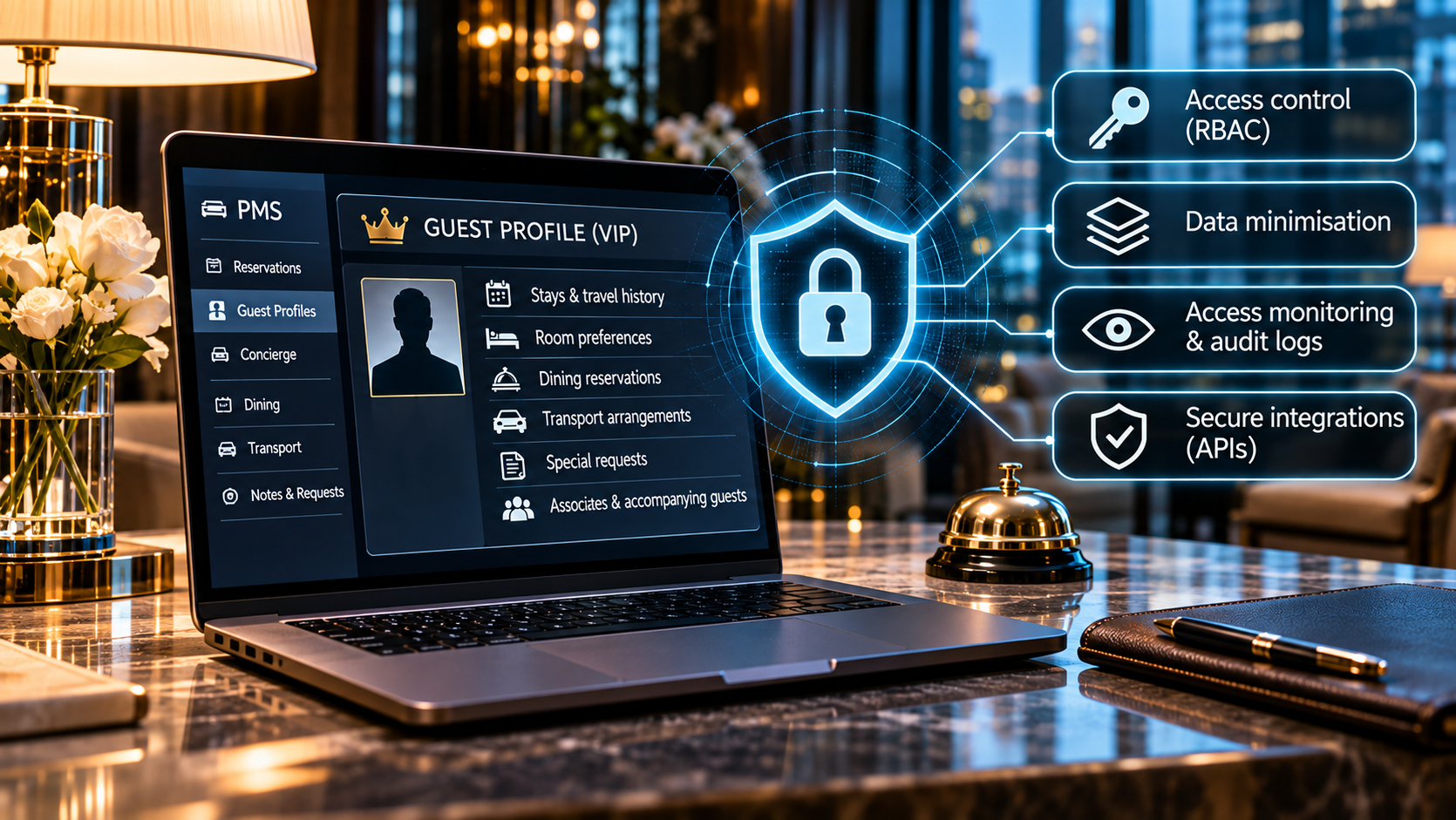
One of the most effective technical safeguards is role-based access control (RBAC).
RBAC assigns permissions according to an employee's responsibilities.
For example:
Reception staff may access current reservations and operational guest information.
Concierge employees may access details relevant to authorised service requests.
Finance personnel may access billing information without unrestricted visibility into unrelated guest preferences.
System administrators may manage infrastructure without automatically requiring access to every guest record.
Sensitive records may require additional restrictions.
Hotels should also maintain audit logs showing who accessed information, when access occurred, and what actions were performed.
For particularly sensitive information, monitoring may identify unusual patterns, such as an employee accessing numerous unrelated guest records.
These logs must themselves be protected and retained in accordance with applicable privacy requirements.
The objective is not to create an atmosphere of suspicion.
It is to establish accountability while protecting both guests and employees.
6. A Real-World Example: The Marriott and Starwood Data Breaches
The intelligence value of hotel data becomes easier to understand when examining the scale of real-world hospitality breaches.
In 2018, Marriott disclosed a major security incident involving the Starwood guest reservation database.
Investigations identified unauthorised access dating back to 2014.
According to subsequent findings published by the United States Federal Trade Commission (FTC), the wider series of Marriott and Starwood security incidents affected more than 344 million customer records worldwide.
The compromised information included various combinations of personal details, loyalty information, payment data, and passport information.
The FTC's 2024 action identified alleged deficiencies involving access controls, network segmentation, software patching, monitoring, and authentication.
The resulting settlement required substantial improvements to the companies' information security practices.
The incident illustrates several important security lessons.
First, hospitality databases can contain information of considerable value.
Second, attackers may maintain unauthorised access for extended periods when monitoring and detection controls are insufficient.
Third, weaknesses in identity management, network architecture, and system administration can combine to create serious exposure.
There is an important distinction, however.
The public findings establish extensive unauthorised access and data compromise. They do not, by themselves, establish that the incident was an espionage operation or that particular intelligence services used the information.
Nevertheless, the categories of information involved demonstrate why hospitality data can be sensitive beyond its immediate financial value.
7. Protecting VIP Guests Without Compromising Service
Luxury hospitality presents a particular challenge.
Exceptional service frequently depends on personalisation.
Staff may remember a returning guest's preferred suite, dining arrangements, transport requirements, or personal preferences.
These details contribute to the guest experience.
However, retaining and distributing unnecessary information increases the potential impact of a breach.
The solution is not to eliminate personalisation.
It is to apply privacy by design to hospitality operations.
This means considering privacy and information security when systems and procedures are developed, rather than adding controls only after an incident.
Practical measures
Data minimisation: Collect and retain only information necessary for legitimate operational purposes.
Restricted VIP records: Limit access to sensitive reservations and guest profiles according to operational requirements.
Secure communications: Avoid sharing confidential guest details through uncontrolled personal messaging applications or unprotected email channels.
Access monitoring: Review unusual access patterns and investigate potential misuse.
Supplier controls: Ensure transport providers, concierge partners, and other third parties receive only the information necessary to deliver their services.
Retention policies: Establish appropriate periods for storing guest information and securely deleting records when no longer required.
These measures can also support compliance with privacy legislation, including the European Union's General Data Protection Regulation (GDPR).
Importantly, privacy should be treated as part of the luxury service experience.
Guests should not need to understand the technical details of access control systems to benefit from effective confidentiality protections.
8. Developing an Intelligence-Aware Cybersecurity Strategy
Traditional hospitality cybersecurity programmes often focus on payment security, malware prevention, and business continuity.
These remain essential.
However, properties serving high-profile clientele should also consider whether their existing security strategy adequately addresses targeted information collection.
A useful starting point is a structured threat assessment.
Guest information
Which records could expose sensitive personal or professional activities?
Access control
Who can view VIP reservations and associated service requests?
Network security
Are guest, administrative, payment, and building systems appropriately segmented?
Third-party access
Which external providers receive guest information, and how is it protected?
Monitoring
Can unusual access to sensitive records be identified and investigated?
Incident response
How would the hotel respond to suspected exposure of a high-profile guest's information?
For larger properties, a more advanced assessment may involve mapping potential attacker behaviour against the MITRE ATT&CK framework.
This framework describes tactics and techniques observed in real-world cyber intrusions.
Relevant categories might include initial access, credential access, discovery, lateral movement, collection, and exfiltration.
For example, a security team might examine whether compromised employee credentials could permit access to reservation records, whether unusual bulk exports would be detected, and whether an attacker could use a compromised application to access unrelated systems.
Such assessments help translate theoretical threats into practical defensive requirements.
They also help distinguish genuine security weaknesses from speculative scenarios.
Incident response for sensitive guest information
Hotels should establish procedures for handling suspected confidentiality incidents.
These should address immediate containment, evidence preservation, internal escalation, legal and regulatory obligations, and appropriately controlled guest communications.
In cases involving particularly sensitive individuals, coordination with the guest's authorised security representatives may also be necessary.
The ability to respond discreetly and effectively can be as important as the preventive controls themselves.
Conclusion: Discretion Must Extend Beyond the Front Desk
Luxury hospitality has always relied on discretion, trust, and attention to detail.
Traditionally, those qualities were demonstrated through professional conduct, carefully managed guest relationships, and physical security.
Today, they must also be reflected in the design and operation of digital systems.
A hotel's reservation database, concierge platform, wireless infrastructure, and employee access permissions can collectively reveal sensitive information about the people staying there.
For most properties, the primary threats will continue to involve financially motivated cybercrime, fraud, and data theft.
For establishments serving influential or security-sensitive guests, the potential threat landscape may be broader.
The objective is not to treat every guest interaction as a possible intelligence operation.
It is to recognise that information about people can be just as valuable as financial information, particularly when those people hold positions of influence or possess commercially sensitive knowledge.
A mature hospitality cybersecurity strategy should therefore protect more than payment systems and operational infrastructure.
It should also protect the confidentiality of the relationships, activities, and personal information entrusted to the establishment.
In luxury hospitality, discretion is not simply a service standard. It is increasingly a cybersecurity requirement.
Technical references and further reading
NIST SP 1800-27 — Securing Property Management Systems
MITRE ATT&CK — Enterprise Threat Framework
NIST SP 800-207 — Zero Trust Architecture
US Federal Trade Commission — Marriott and Starwood Data Security Investigation (2024)
US National Counterintelligence and Security Center — Travel Security Guidance
European Union — General Data Protection Regulation (GDPR)