
From compromised reservation systems to ransomware and guest data theft, the hospitality industry faces a growing range of digital threats. Understanding where the vulnerabilities exist is the first step towards protecting both the business and its guests.
Hospitality has undergone a remarkable digital transformation over the past two decades. Hotels now rely on interconnected property management systems, online booking platforms, electronic room access, cloud-based payment processing, and increasingly sophisticated guest services. Restaurants have followed a similar path, integrating point-of-sale systems with inventory management, delivery platforms, staff scheduling, and customer loyalty programmes.
These technologies have improved operational efficiency and the guest experience. However, they have also introduced a significant and often underestimated problem: every connected system potentially creates another entry point for a cyberattack.
For hospitality operators, cybersecurity is no longer simply an IT department responsibility. It is a fundamental component of business continuity, financial risk management, and guest protection.
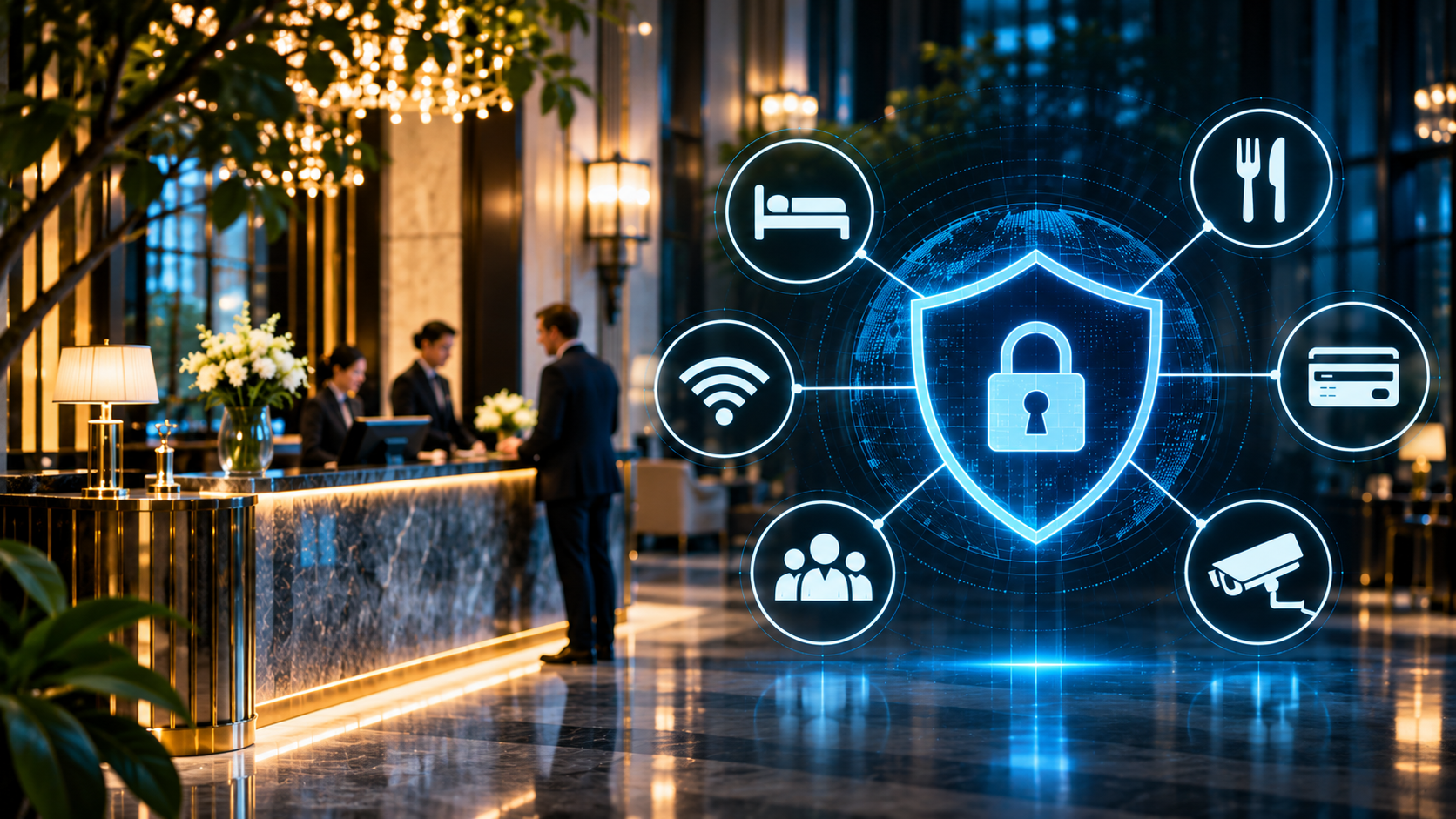
Why Is Hospitality Particularly Vulnerable?
The hospitality industry presents an unusually attractive environment for cybercriminals because it combines three characteristics: valuable information, complex technological infrastructure, and operational environments where uninterrupted service is essential.
A typical hotel may process thousands of guest records, payment transactions, reservation modifications, and third-party communications every week.
Behind the scenes, multiple systems exchange information continuously.
These may include:
Property Management Systems (PMS): Guest reservations, room allocations, billing, and personal information.
Point-of-Sale (POS) systems: Restaurant, bar, spa, and retail transactions.
Customer Relationship Management (CRM): Guest preferences, loyalty information, and marketing records.
Building Management Systems (BMS): Heating, ventilation, access control, and other building functions.
Third-party integrations: Online travel agencies, payment gateways, channel managers, and external service providers.
Each system has its own software, authentication mechanisms, user permissions, and maintenance requirements.
The challenge is not necessarily that these technologies are inherently insecure. It is that their integration creates a complex environment in which a weakness in one component can potentially affect others.
In cybersecurity, we refer to the collection of possible entry points as the attack surface.
The larger and less controlled that surface becomes, the more opportunities an attacker may have to identify and exploit a vulnerability.
1. Property Management Systems: The Digital Heart of a Hotel
A hotel's PMS is among its most business-critical systems.
It can contain guest names, contact information, reservation histories, billing records, room assignments, and information about individual guest preferences.
Depending on the platform and configuration, it may also integrate with payment services, electronic locks, housekeeping applications, and external booking platforms.
This concentration of information makes the PMS an attractive target.
The US National Institute of Standards and Technology (NIST) has specifically addressed this risk in its cybersecurity guidance for hospitality property management systems.
A central concern is that compromise of a connected application or account could provide an attacker with opportunities to access additional systems or sensitive information.
How an attack might unfold
Consider a hypothetical hotel where a front-desk employee receives a convincing email appearing to originate from a booking platform.
The message claims that a reservation requires urgent verification and directs the employee to a fraudulent login page.
The employee enters their credentials.
If the attacker successfully obtains usable authentication information and the account lacks adequate additional protections, they may be able to access the reservation platform.
From there, the consequences depend on the permissions associated with the account and the security of connected systems.
Potential outcomes include:
Unauthorised access to guest records.
Fraudulent reservation modifications.
Exposure of personal information.
Manipulation of payment instructions.
Further attempts to compromise connected applications.
This is an example of credential phishing, a form of social engineering in which an attacker manipulates a legitimate user into revealing authentication information.
Importantly, the initial compromise does not necessarily require exploiting a sophisticated software vulnerability.
Sometimes the weakest point is simply a convincing message delivered at the busiest moment of a receptionist's shift.
Technical considerations
A properly secured PMS environment should incorporate several controls:
Multi-factor authentication (MFA): An additional authentication factor reduces reliance on passwords alone. Phishing-resistant methods, such as FIDO2 security keys or passkeys, provide stronger protection against credential theft.
Role-based access control (RBAC): Employees should only access information and functions necessary for their responsibilities.
Centralised logging: Authentication events, permission changes, administrative actions, and sensitive data access should be recorded and monitored.
Network segmentation: Where applicable, PMS infrastructure should be isolated from unrelated networks, with communication restricted to approved services.
These measures follow the principle of least privilege: no employee, application, or system should have more access than necessary.
2. Restaurant POS Systems: More Than Just Payment Terminals
Restaurant cybersecurity is frequently underestimated because operators associate cyberattacks primarily with large corporations and financial institutions.
In reality, modern restaurants operate increasingly sophisticated digital environments.
A single POS platform may connect payment terminals, kitchen display systems, online ordering, stock management, accounting software, and customer databases.
For restaurant groups operating multiple locations, these connections become more extensive.
One compromised account or poorly secured integration can potentially expose information across several establishments.
Understanding the payment security risk
Attackers may target payment environments through compromised administrator accounts, vulnerable software, malicious code, or improperly secured remote-access services.
The precise risk depends heavily on how the payment infrastructure is designed.
For example, a restaurant using a properly configured, independently managed payment terminal may have significantly less exposure to cardholder data than one whose systems directly handle sensitive payment information.
This is where the Payment Card Industry Data Security Standard (PCI DSS) becomes relevant.
PCI DSS establishes technical and organisational requirements for protecting payment account data.
However, PCI DSS compliance should not be confused with comprehensive cybersecurity.
A business may meet its applicable payment security requirements while still having weaknesses in email security, employee authentication, backup procedures, or third-party access.
What restaurant operators should examine
Operators should understand who can remotely access their POS infrastructure, how software updates are deployed, whether administrator accounts are shared, and how payment systems are separated from other networks.
A particularly important question is whether the restaurant's guest Wi-Fi, office computers, and payment infrastructure are appropriately isolated.
This leads to another significant hospitality vulnerability.
3. Guest Wi-Fi and the Risks of Poor Network Segmentation
Providing reliable internet access has become an expected part of hospitality service.
However, guest connectivity should never provide unrestricted access to internal business infrastructure.
Imagine a hotel where guest Wi-Fi, administrative workstations, and certain operational devices are connected to the same inadequately protected network.
An attacker who gains access to one vulnerable device may attempt to discover other systems, identify exposed services, or exploit weaknesses elsewhere.
This technique is known as lateral movement.
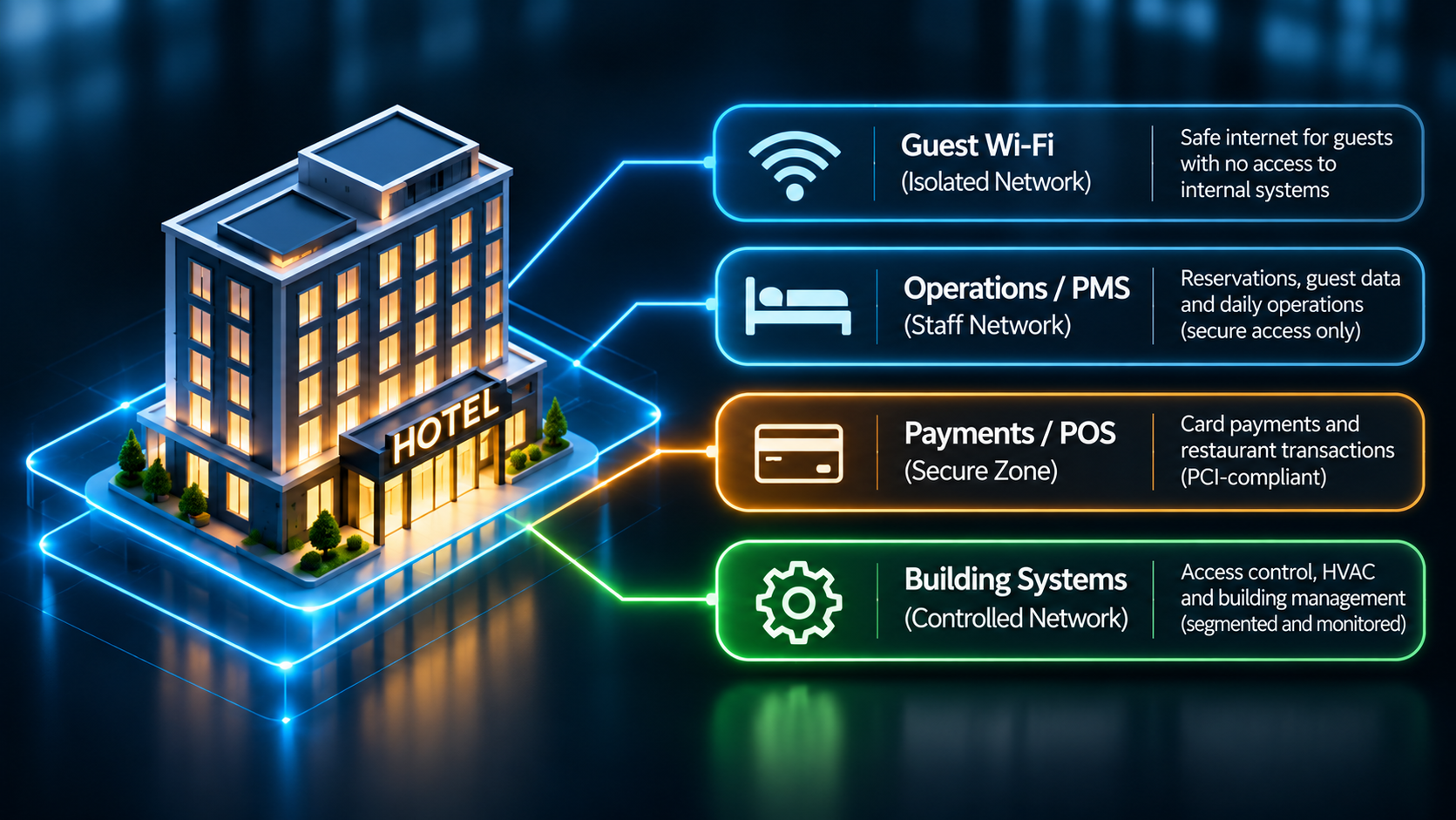
In a well-designed environment, network segmentation limits which systems can communicate with one another.
For example:
Network segmentTypical systemsGuest networkGuest phones, laptops, and tabletsCorporate networkAdministration, finance, and office systemsPayment environmentPOS terminals and payment infrastructureOperational technologyBuilding controls and connected equipmentManagement networkNetwork administration and infrastructure management
Segmentation may be implemented using VLANs, firewalls, access control lists, and other network security controls.
A VLAN alone does not guarantee isolation. Effective protection requires properly configured traffic restrictions between network segments.
For larger properties, a zero-trust approach can provide further protection.
Zero trust is a security architecture based on continuously evaluating access requests rather than automatically trusting users or devices because they are connected to an internal network.
In practical terms, a device connected to the hotel's network should not automatically gain access to sensitive systems.
Access should be explicitly authorised, appropriately authenticated, and limited to the resources required.
4. Ransomware: When a Cyberattack Becomes an Operational Crisis
For many hospitality businesses, ransomware represents one of the most disruptive cyber threats.
Ransomware is malicious software or attacker activity designed to deny access to systems or data, commonly through encryption, while demanding payment.
Modern ransomware incidents may also involve the theft of sensitive information and threats to publish it.
The consequences extend well beyond an inaccessible computer.
Consider the potential operational impact on a hotel:
Reception staff cannot access reservations or room allocations.
Payment processing becomes unavailable.
Housekeeping loses access to room status information.
Finance and accounting systems become inaccessible.
Guest communications and administrative functions are disrupted.
Even where physical room access and other operational systems remain functional, losing the PMS can severely affect a hotel's ability to operate.
A restaurant may experience similar disruption if its POS, ordering, inventory, or administrative systems become unavailable.
Backups are essential, but not sufficient
A common misconception is that maintaining backups automatically protects a business against ransomware.
Backups are critical, but their effectiveness depends on how they are configured and maintained.
If backup repositories remain accessible through compromised administrator credentials, attackers may attempt to delete or encrypt them.
A resilient backup strategy should include:
Regular, automated backups of critical systems and data.
Offline or immutable backup copies protected against unauthorised modification.
Restricted access to backup administration.
Monitoring for backup failures or unusual activity.
Periodic restoration tests to verify that systems can actually be recovered.
Operators should also define two important business continuity measurements.
Recovery Time Objective (RTO): How quickly a critical system must be restored after disruption.
Recovery Point Objective (RPO): How much data loss, measured in time, the business can tolerate.
For example, a hotel might establish an RTO of four hours for its reservation system and an RPO of 15 minutes.
These are illustrative targets, not universal standards. The appropriate values depend on operational requirements, technical feasibility, and cost.
The important point is that recovery expectations should be defined before an incident occurs.
5. The Human Factor: Hospitality's Unique Security Challenge
Hospitality businesses operate under conditions that create particular challenges for cybersecurity.
Staff turnover can be high, seasonal employment is common, and employees frequently work under significant time pressure.
Receptionists, restaurant managers, and reservations teams also communicate constantly with unfamiliar individuals.
These conditions create opportunities for social engineering.
An attacker might impersonate a guest requesting an urgent booking modification, a supplier requesting updated payment details, or an IT technician claiming to need immediate access to a system.
The objective may be to obtain credentials, persuade an employee to transfer money, or gain access to confidential information.
The solution is not simply to tell employees to be more careful.
Security procedures must be designed around the realities of hospitality operations.
For example, a hotel should establish a clear process for verifying unusual payment requests without forcing reception staff to make complicated technical judgements.
Likewise, employees should have an accessible method of reporting suspicious messages without fear of punishment for making a mistake.
A strong security culture depends on clear procedures, realistic training, and management support.
6. Third-Party Suppliers: The Security Risks Beyond Your Own Business
Hospitality operations increasingly depend on external technology providers.
These include booking platforms, payment processors, software vendors, managed IT providers, digital marketing platforms, and specialist hospitality applications.
Each relationship can introduce additional security dependencies.
An attacker who compromises a supplier may gain access to customer environments through legitimate integrations, support accounts, or trusted communication channels.
This is commonly described as a supply-chain or third-party compromise.
For hotel groups, the challenge becomes more significant when multiple properties share common software platforms or administrative infrastructure.
Security assessments should therefore consider not only internal systems but also the organisations that maintain, connect to, or process information on behalf of the business.
Important questions include:
What information can each supplier access?
Do suppliers use MFA and individual accounts?
Is remote support access restricted and monitored?
How quickly will the supplier notify the business of a security incident?
What happens if the supplier's service becomes unavailable?
Contractual assurances are useful, but they should be supported by practical technical controls and periodic reviews.
7. Protecting High-Profile Guests: A Different Level of Risk
For luxury hotels and establishments serving high-net-worth individuals, cybersecurity introduces another dimension: personal security and confidentiality.
Guest information may reveal considerably more than a name and room number.
Reservation records, travel itineraries, concierge requests, transport arrangements, and service preferences can collectively expose sensitive information about an individual's movements and activities.
For prominent executives, public figures, or other high-profile guests, this information may be valuable to criminals, stalkers, or individuals seeking confidential commercial intelligence.
The risk is not limited to sophisticated external hacking.
Excessive employee access, insecure communications, or poorly controlled information sharing can also expose sensitive details.
Luxury hospitality businesses should therefore consider privacy protection as part of their broader security architecture.
This may include restricting access to VIP reservations, auditing sensitive record access, minimising unnecessary information retention, and establishing discreet procedures for handling confidential guest requests.
In luxury hospitality, discretion has always been an essential element of service.
Increasingly, that discretion must extend to digital systems as well as personal conduct.
8. Building a Practical Cybersecurity Strategy
Effective cybersecurity does not necessarily require a large internal security department or expensive enterprise software.
It requires a structured understanding of risk.
A useful starting point is the NIST Cybersecurity Framework 2.0, which organises cybersecurity risk management into six functions.
FunctionHospitality applicationGovernEstablish security responsibilities, policies, and acceptable risk levelsIdentifyInventory critical systems, sensitive data, and third-party dependenciesProtectImplement MFA, access controls, segmentation, and secure configurationsDetectMonitor suspicious logins, unusual activity, and security alertsRespondEstablish procedures for containing incidents and coordinating communicationsRecoverRestore systems, validate backups, and resume essential operations
For a smaller hotel or restaurant, implementing these principles may begin with a relatively straightforward assessment.
The first priority is visibility.
Management should understand which systems are essential to daily operations, what information those systems hold, who can access them, and what would happen if they became unavailable.
From there, security improvements can be prioritised according to business impact and likelihood of compromise.
For example, enforcing MFA on administrator accounts and securing exposed remote-access services may deliver greater immediate risk reduction than purchasing an expensive monitoring platform that nobody is qualified to operate.
Similarly, a properly tested backup and recovery procedure may be more valuable than a lengthy security policy that employees never read.
The objective is not to eliminate every conceivable threat.
It is to reduce the likelihood of serious incidents, limit their potential impact, and ensure that the business can continue operating when something goes wrong.
Conclusion: Cybersecurity Is Now Part of Hospitality Management
Hospitality has always depended on trust.
Guests trust hotels to protect their belongings, respect their privacy, and provide a safe environment. Restaurant customers trust operators to handle their payments and personal information responsibly.
As hospitality becomes more digitally connected, that responsibility increasingly extends into cybersecurity.
The most significant risks do not always originate from sophisticated hackers exploiting obscure technical vulnerabilities.
They may begin with a compromised employee account, an improperly configured network, an overlooked software update, or a third-party integration with excessive permissions.
For hotel and restaurant operators, the critical question is no longer whether cybersecurity deserves attention.
It is whether the business understands its digital exposure well enough to manage it.
A secure hospitality operation is not simply one that protects information. It is one that can maintain guest confidence, preserve operational continuity, and respond effectively when its systems are challenged.
Technical references and further reading
NIST SP 1800-27 — Securing Property Management Systems
NIST Cybersecurity Framework 2.0
PCI Security Standards Council — Payment Card Industry Data Security Standard (PCI DSS)
NIST guidance on identity, access management, and cybersecurity risk management