
From reception desks and concierge teams to housekeeping and restaurant staff, hospitality employees routinely handle sensitive information and interact with critical systems. Understanding how legitimate access, human error, and social engineering can create cybersecurity vulnerabilities is essential to protecting both guests and hotel operations.
A luxury hotel may invest heavily in cybersecurity.
Its network infrastructure may be protected by firewalls, its payment systems secured according to industry standards, and its reservation databases hosted by reputable technology providers.
Yet a single employee account with excessive permissions, an improperly shared guest itinerary, or a convincing fraudulent telephone call may undermine those investments.
This is one of the fundamental challenges of hospitality cybersecurity.
Hotels and restaurants are environments built around human interaction.
Employees are expected to be helpful, responsive, discreet, and capable of resolving problems quickly. They regularly communicate with guests, suppliers, contractors, and colleagues across multiple departments.
These interactions are essential to delivering exceptional service.
They also create opportunities for mistakes, manipulation, and unauthorised access.
In hospitality, the human element is not simply another cybersecurity consideration. It is embedded in almost every operational process.
The challenge is not to eliminate trust in employees.
It is to ensure that trust is supported by appropriate access controls, secure procedures, effective training, and accountability.
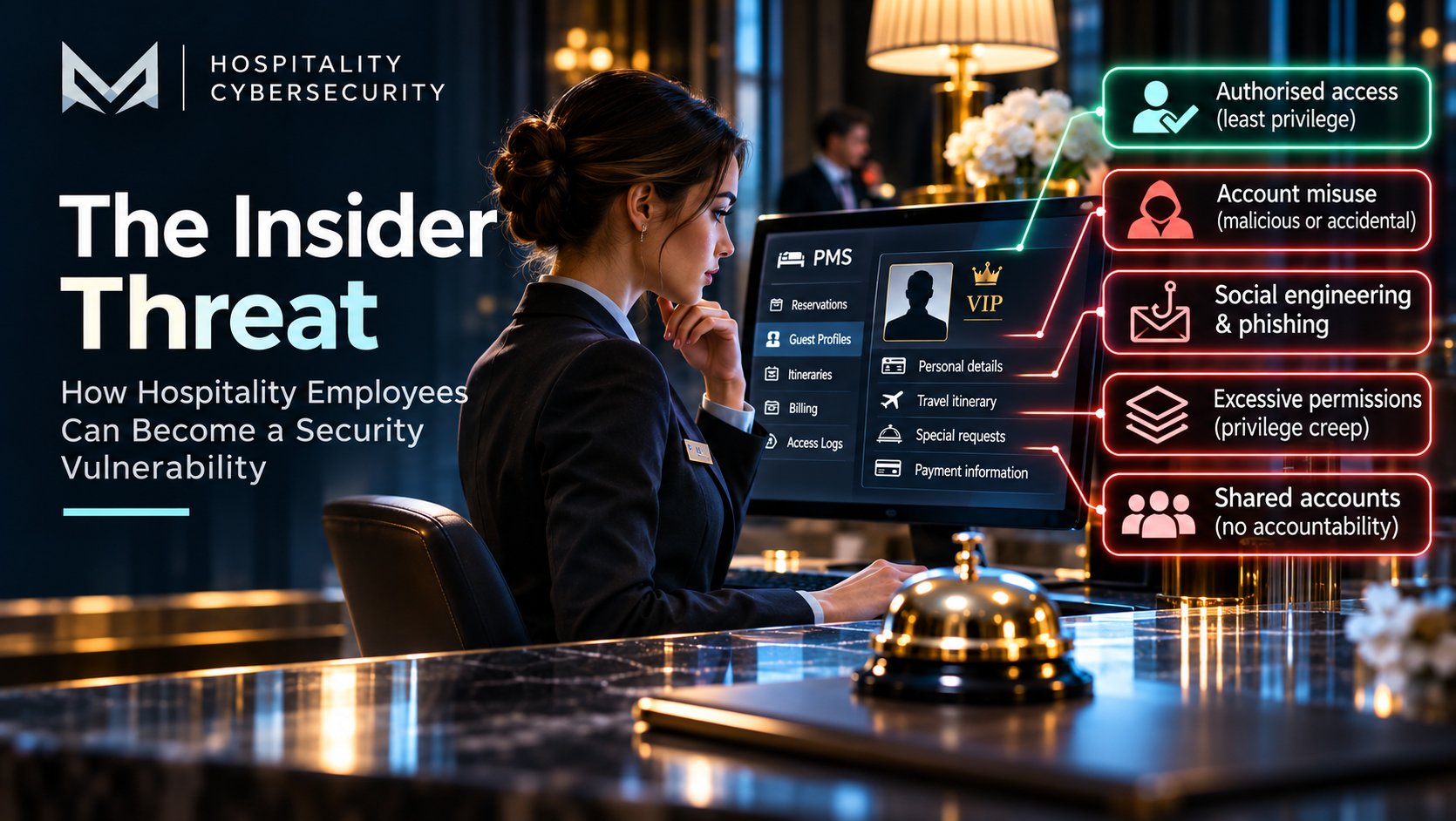
1. Understanding the Insider Threat in Hospitality
The term insider threat is sometimes associated with disgruntled employees deliberately stealing information or sabotaging systems.
Such incidents are possible, but they represent only part of the problem.
An insider is generally someone who has, or previously had, authorised access to an organisation's systems, facilities, information, or resources.
An insider-related security incident may involve deliberate misconduct, negligence, accidental disclosure, or the exploitation of legitimate employee access by an external attacker.
These distinctions matter because the appropriate security response depends on the nature of the threat.
Three categories of insider risk
1. Malicious insiders
Individuals who intentionally misuse their access to obtain information, commit fraud, disrupt operations, or benefit an external party.
For example, an employee might deliberately retrieve confidential guest information for unauthorised purposes.
2. Negligent or accidental insiders
Employees who unintentionally expose information or compromise security through mistakes, inadequate training, or unsafe working practices.
Examples include sending confidential documents to the wrong recipient, using weak passwords, or storing sensitive information in an unapproved application.
3. Compromised insiders
Employees whose accounts or devices are exploited by external attackers.
A receptionist may have no malicious intentions, yet an attacker who obtains their credentials could potentially access systems using that employee's legitimate permissions.
These categories should not be confused.
An employee who falls victim to a sophisticated phishing attack is not equivalent to someone deliberately selling guest information.
However, from a technical perspective, both situations can result in unauthorised access to the same systems.
Why the human element matters
The Verizon 2025 Data Breach Investigations Report identified human involvement in approximately 60% of the breaches examined.
This includes various forms of credential misuse, social engineering, errors, and other human-related activity.
The statistic applies across the report's dataset rather than specifically to hospitality.
Nevertheless, it illustrates why technical security measures alone cannot address every organisational vulnerability.
For hotels and restaurants, the human dimension is particularly significant because so much operational information must be accessible to employees throughout the working day.
2. The Reception Desk: A Concentration of Sensitive Information
The reception desk is one of the most information-intensive environments in a hotel.
Reception employees may access reservation details, identification information, payment records, room assignments, arrival and departure schedules, and guest contact information.
They may also handle requests from personal assistants, travel agencies, corporate clients, and other third parties.
This creates an unusually broad range of responsibilities.
It also creates an attractive opportunity for social engineering.
A hypothetical scenario
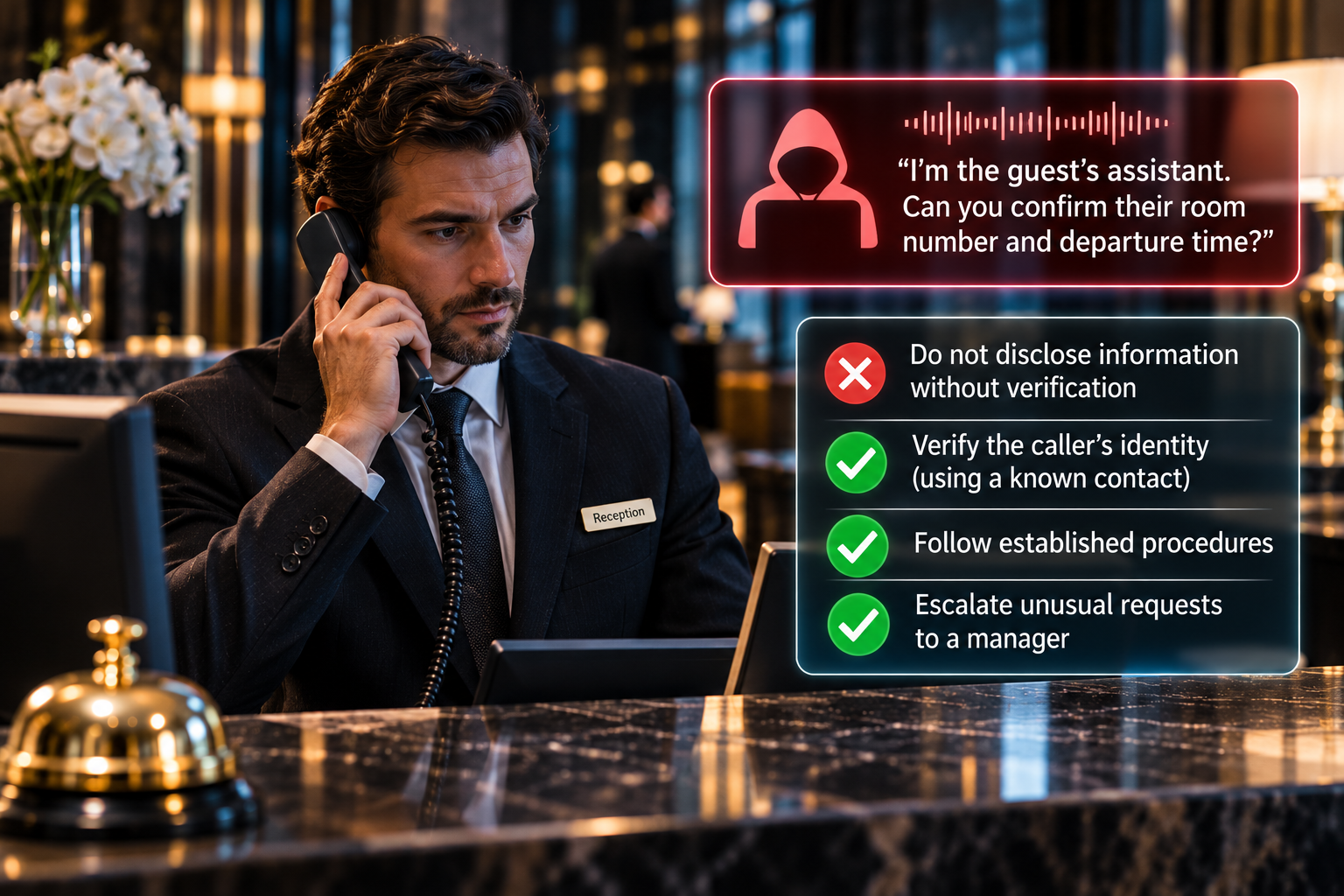
Consider a five-star hotel receiving a telephone call from someone claiming to be the personal assistant of an important guest.
The caller explains that the guest has lost their telephone and urgently needs confirmation of their room number and departure arrangements.
The caller may know the guest's name, employer, and approximate arrival date.
These details make the request appear credible.
A receptionist attempting to provide excellent service might disclose information without sufficiently verifying the caller's identity or authority.
No malware is involved.
No technical vulnerability has been exploited.
The security failure occurs through the manipulation of a legitimate operational process.
Social engineering and authority
Social engineering involves manipulating people into performing actions or disclosing information they would not otherwise provide.
Attackers may exploit urgency, authority, familiarity, or the expectation of helpful service.
Hospitality is particularly susceptible to these pressures because refusing or delaying a guest request may be perceived as poor service.
The solution is to establish procedures that allow employees to verify sensitive requests without creating unnecessary friction.
For example, staff should avoid disclosing room numbers, travel details, or confidential guest information to unverified callers.
Where appropriate, requests can be confirmed through a previously established contact method or escalated to an authorised manager.
Good service should never require an employee to bypass a necessary security check.
3. Excessive Access Privileges: When Employees Can See Too Much
One of the most common architectural weaknesses in business applications is excessive access.
Employees may receive broad permissions because those permissions are convenient, because software defaults are poorly configured, or because access rights have accumulated over time.
In hospitality, this can affect property management systems (PMS), customer relationship management platforms (CRM), point-of-sale systems (POS), and administrative applications.
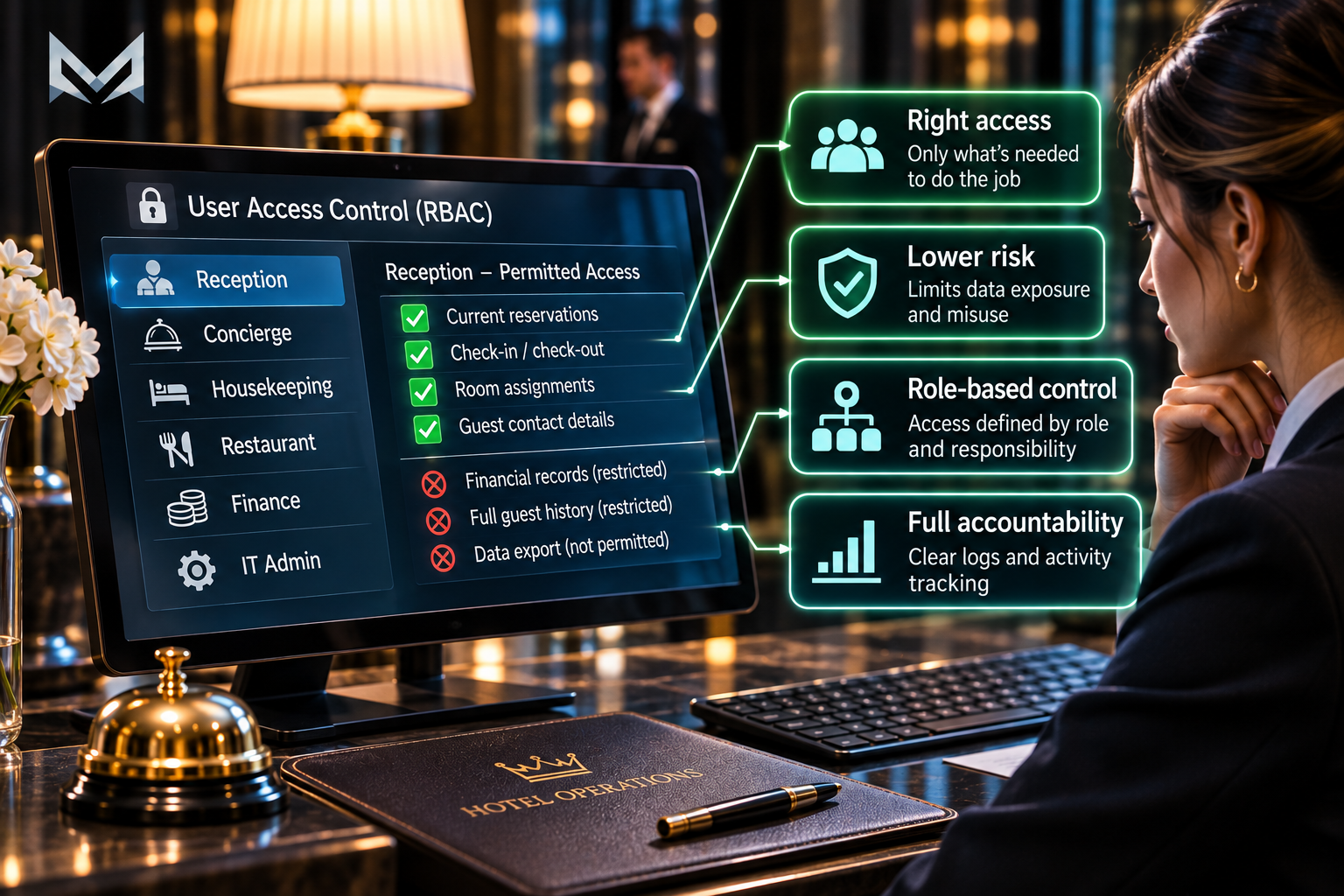
The principle of least privilege
The principle of least privilege requires users to receive only the permissions necessary to perform their authorised responsibilities.
A restaurant employee, for example, may need access to a guest's dining reservation and relevant dietary requirements.
They do not necessarily need access to that guest's passport information, complete travel history, or financial records.
Similarly, housekeeping staff may need to know which rooms require servicing without requiring unrestricted access to the hotel's full reservation database.
A practical access model might look like this:
Reception
Necessary information: Reservations, check-in details, room assignments
Access that should generally be restricted: Unrelated financial or administrative records
Concierge
Necessary information: Authorised guest requests, transport and dining arrangements
Access that should generally be restricted: Unrestricted historical guest profiles
Housekeeping
Necessary information: Room status, service instructions
Access that should generally be restricted: Payment details and confidential correspondence
Restaurant
Necessary information: Dining bookings, relevant dietary information
Access that should generally be restricted: Passport records and unrelated travel history
Finance
Necessary information: Billing, invoices, authorised transactions
Access that should generally be restricted: Unnecessary personal preferences and itineraries
IT administration
Necessary information: System configuration and maintenance
Access that should generally be restricted: Guest record contents unless specifically authorised
The precise permissions depend on the property and its operational requirements.
However, the underlying principle remains consistent.
Access should be determined by business necessity rather than employee seniority, convenience, or informal trust.
Role-based access control
Role-based access control (RBAC) provides a practical method of implementing least privilege.
Users are assigned roles, and those roles determine which functions and records they can access.
For example, a receptionist may be authorised to modify current reservations but not to export the entire customer database.
An IT technician may be permitted to manage system infrastructure without automatically receiving unrestricted access to confidential guest information.
For particularly sensitive records, additional restrictions may be necessary.
These can include record-level authorisation, approval requirements, or time-limited access.
The National Institute of Standards and Technology addresses these issues in its hospitality-specific guidance, NIST SP 1800-27, Securing Property Management Systems.
The guidance emphasises access control, prevention of privilege escalation, and monitoring of system activity.
4. Shared Accounts: A Convenient but Dangerous Practice
Hospitality operations frequently involve shift work.
Employees may use the same reception workstation, restaurant terminal, or administrative computer throughout the day.
In poorly managed environments, this can lead to shared usernames and passwords.
A department may use one account because it is convenient and avoids repeated authentication.
However, shared accounts create serious accountability problems.
Why individual identities matter
Imagine a hotel PMS where every reception employee uses the same login.
A confidential guest record is accessed outside normal operating procedures.
The system logs show which account was used, but not necessarily which employee performed the action.
Investigating the incident becomes significantly more difficult.
Shared credentials also create problems when employees leave the organisation.
If passwords are known to multiple people, removing one employee's access may require changing credentials across an entire department.
Better identity management
Each employee should have a unique account wherever the system supports it.
Access should be linked to individual responsibilities and removed promptly when employment ends.
For privileged accounts and other appropriate systems, multi-factor authentication (MFA) provides an additional layer of protection.
MFA requires more than one authentication factor, such as a password combined with a security key or approved authenticator.
Phishing-resistant authentication methods, including FIDO2 security keys and passkeys, offer stronger protection against certain credential theft techniques.
For shared physical workstations, organisations can also consider secure single sign-on, automatic session locking, and fast user-switching procedures.
The objective is to maintain operational efficiency without sacrificing accountability.
5. Phishing and the Compromised Employee Account
Hospitality employees receive a considerable volume of external communication.
Reservation requests, invoices, supplier correspondence, guest enquiries, and booking-platform notifications may arrive throughout the day.
This creates opportunities for attackers to impersonate legitimate contacts.
A fraudulent email might appear to originate from a booking platform and claim that a reservation requires urgent attention.
Another might impersonate a supplier requesting updated payment information.
An attacker could also pose as an internal manager asking an employee to open a document or verify account credentials.
From phishing to unauthorised access
A successful phishing attack may allow an external attacker to obtain credentials or authentication material.
The attacker may then attempt to access systems using the employee's identity.
Depending on the account's permissions, this could expose reservations, guest profiles, correspondence, or administrative functions.
The attacker may also attempt to access additional systems.
This activity is known as lateral movement.
If the compromised account has excessive permissions, the potential impact increases.
Technical safeguards
Effective protection should combine several controls.
Email authentication: SPF, DKIM, and DMARC help protect domains against certain forms of email spoofing when correctly configured.
Phishing-resistant MFA: Reduces the effectiveness of credential phishing against supported authentication systems.
Conditional access: Restricts or challenges authentication attempts based on relevant security conditions.
Endpoint protection: Helps identify malicious activity on employee devices.
Access monitoring: Detects suspicious authentication behaviour and unusual account activity.
Employee training: Helps staff recognise suspicious requests and report them promptly.
No single control eliminates the threat.
A mature security strategy assumes that some attacks will reach employees and focuses on preventing a single mistake from developing into a major incident.
6. Housekeeping, Maintenance, and Physical Access
Cybersecurity is frequently discussed as though it exists entirely within computers and networks.
In hospitality, physical access is equally important.
Housekeeping and maintenance teams routinely enter guest rooms, service areas, offices, and technical spaces.
These activities are legitimate and essential.
However, they may create opportunities for accidental exposure, unauthorised device access, or interference with equipment.
Physical access and digital security
A guest room may contain laptops, mobile devices, documents, and connected equipment.
Administrative offices may contain unlocked workstations, printed guest lists, or network-connected devices.
Technical rooms may provide access to network switches, building management systems, or surveillance infrastructure.
Physical access does not automatically provide digital access.
However, poorly protected devices and infrastructure can create additional risks.
For example, an unattended administrative workstation with an active session may allow someone to access information without knowing the account password.
Similarly, exposed network ports or unsecured technical equipment may provide opportunities for unauthorised interaction with internal systems.
Practical protection
Hotels should establish appropriate controls for sensitive areas and equipment.
These may include secure workstation configurations, automatic screen locking, controlled access to technical rooms, and clear procedures for handling confidential documents.
Staff should also understand how to report suspicious devices, unusual requests, or unexpected access to restricted areas.
The objective is not to prevent employees from performing their duties.
It is to ensure that legitimate physical access does not unintentionally create unrestricted digital access.
7. Temporary Staff, Contractors, and High Employee Turnover
Hospitality businesses frequently rely on seasonal workers, temporary employees, agency personnel, and external contractors.
Large hotels may also employ outsourced housekeeping, security, maintenance, or catering teams.
These arrangements provide operational flexibility.
They can also complicate identity and access management.
The employee lifecycle
Cybersecurity controls should account for the complete employee lifecycle:
Onboarding: Creating individual accounts with appropriate permissions.
Role changes: Reviewing access when employees move between departments.
Temporary assignments: Granting additional permissions only for the required period.
Offboarding: Removing accounts, revoking credentials, and recovering access devices when employment or contracts end.
A common operational weakness occurs when access rights are not reviewed after an employee changes responsibilities.
Over time, employees may accumulate permissions from several previous roles.
This is sometimes described as privilege creep.
Third-party access
Contractors and external suppliers may require access to hotel systems for legitimate purposes.
For example, a PMS vendor may need remote access for technical support.
Such access should be appropriately authorised, restricted, monitored, and removed when no longer required.
Privileged remote access may warrant additional safeguards, including MFA, session logging, and time-limited permissions.
Hotels should also maintain an inventory of active accounts and conduct periodic access reviews.
These measures help ensure that former employees and contractors do not retain unnecessary access to sensitive systems.
8. Detecting Suspicious Activity Without Creating a Surveillance Culture
Monitoring employee activity can be an important cybersecurity safeguard.
However, it must be implemented carefully.
Excessive or poorly governed monitoring can undermine trust, create privacy concerns, and produce large volumes of information with limited security value.
A more effective approach focuses on security-relevant events.
Audit logging
An audit log records activity within an application or system.
For hospitality platforms, useful events may include:
Access to sensitive guest records.
Failed and successful authentication attempts.
Changes to user permissions.
Bulk exports of customer information.
Administrative configuration changes.
Unusual access outside expected working patterns.
These records can support both security investigations and routine monitoring.
For example, repeated attempts to access unrelated VIP profiles may justify further review.
However, unusual activity does not automatically establish malicious intent.
An employee may be covering another department, assisting with an exceptional guest request, or responding to an operational incident.
Alerts therefore require appropriate context and human assessment.
SIEM and behavioural analytics
Larger organisations may use a Security Information and Event Management (SIEM) platform to collect and correlate security events.
A SIEM can combine information from identity systems, applications, endpoints, and network infrastructure.
For example, an alert might be generated when an account authenticates from an unusual location and subsequently attempts to export a large volume of guest information.
Some organisations also use User and Entity Behaviour Analytics (UEBA) to identify deviations from established patterns.
These tools can improve visibility, but they require careful configuration.
Poorly designed rules may generate excessive false positives, while incomplete logging can create blind spots.
Monitoring must also comply with applicable privacy and employment requirements.
In the European Union, this includes consideration of GDPR principles such as transparency, proportionality, purpose limitation, and data minimisation.
Security monitoring should protect the organisation and its guests, not become an uncontrolled mechanism for observing employees.
9. Creating a Security-Conscious Hospitality Culture
Technical safeguards are essential, but they work best when supported by clear operational expectations.
Hospitality employees should understand not only what procedures they must follow, but why those procedures matter.
Generic cybersecurity training may be insufficient.
A restaurant employee, concierge, and hotel receptionist encounter different risks during their daily responsibilities.
Training should reflect those differences.
Role-specific security awareness
Reception teams should understand how to verify requests for confidential guest information and recognise suspicious booking communications.
Concierge employees should know how to protect itineraries, confirm changes to sensitive arrangements, and communicate securely with external providers.
Restaurant teams should understand payment security, reservation confidentiality, and the risks of fraudulent supplier communications.
Housekeeping and maintenance teams should know how to report suspicious devices, protect physical access, and avoid unnecessary interaction with guest equipment.
Managers should understand access approvals, incident escalation, and the importance of enforcing security procedures consistently.
Avoiding a blame-based culture
Employees must feel able to report mistakes quickly.
If an employee accidentally sends information to the wrong recipient or interacts with a suspicious email, delaying the report may make the incident more difficult to contain.
An effective security culture encourages prompt reporting and distinguishes genuine mistakes from deliberate misconduct.
This does not eliminate accountability.
It recognises that fear of punishment can discourage employees from reporting incidents while they are still manageable.
The objective is to create employees who understand security, not employees who are afraid of it.
10. A Practical Insider Risk Assessment for Hotels and Restaurants
Hospitality operators do not necessarily need a large internal cybersecurity department to begin addressing insider risk.
A structured assessment can identify many common weaknesses.
The following questions provide a useful starting point:
Identity management
Does every employee have an individual account?
Access control
Are permissions restricted according to operational responsibilities?
Guest confidentiality
Can employees access VIP records unrelated to their duties?
Authentication
Is MFA enabled for appropriate systems and privileged accounts?
Employee lifecycle
Are access rights removed promptly when employees leave?
Monitoring
Are sensitive data access and administrative actions logged?
Social engineering
Can staff verify unusual requests without bypassing procedures?
Third-party access
Are contractor and supplier permissions appropriately controlled?
Incident reporting
Do employees know how to report suspected security incidents?
Training
Is cybersecurity awareness relevant to each department's responsibilities?
For a larger hotel group, this assessment can be integrated into an established cybersecurity governance programme.
The NIST Cybersecurity Framework 2.0 provides a useful structure for managing organisational cybersecurity risk.
The NIST SP 1800-27 practice guide provides more specific guidance for securing hospitality property management systems.
Organisations may also use MITRE ATT&CK to examine how compromised credentials, privilege escalation, and lateral movement could affect their environments.
A useful technical assessment might examine whether a compromised reception account could access unrelated guest profiles, export large datasets, or reach administrative systems.
The purpose is to identify realistic attack paths and implement proportionate safeguards.
Prioritising improvements
For hotels beginning this process, several measures deserve particular attention.
First, establish an accurate inventory of employee and contractor accounts.
Second, remove unnecessary permissions and eliminate shared credentials where possible.
Third, introduce appropriate MFA and strengthen account lifecycle management.
Fourth, ensure that sensitive system activity is logged and reviewed.
Finally, provide practical, role-specific training supported by clear reporting procedures.
These measures address both deliberate misuse and accidental exposure while reducing the impact of compromised accounts.
Conclusion: Trust Requires Structure
Hospitality is fundamentally a people business.
Exceptional service depends on employees understanding guests, anticipating requirements, and responding effectively to unexpected situations.
These qualities should not be sacrificed in the pursuit of cybersecurity.
However, neither should they be used to justify unrestricted access, informal security procedures, or inadequate accountability.
The insider threat is not simply a question of whether employees can be trusted.
It is a question of whether the organisation has designed its systems and procedures to protect sensitive information even when people make mistakes, accounts are compromised, or legitimate access is misused.
For luxury hotels, the consequences can be particularly significant.
Guest records may contain sensitive travel arrangements, personal preferences, confidential correspondence, and information relating to influential individuals.
Protecting that information requires a combination of technical controls, operational discipline, and effective staff awareness.
A mature cybersecurity strategy does not assume that every employee is a threat. It ensures that no single employee account, mistake, or manipulated interaction can unnecessarily compromise the security of the entire establishment.
In luxury hospitality, trust remains essential.
But the strongest trust is supported by systems designed to protect everyone involved.
Technical references and further reading
NIST SP 1800-27 — Securing Property Management Systems
NIST Cybersecurity Framework 2.0 — Organisational cybersecurity risk management
CISA — Insider Threat Mitigation Guide
UK National Cyber Security Centre — Reducing Data Exfiltration by Malicious Insiders
Verizon — 2025 Data Breach Investigations Report
NIST SP 800-53 — Security and Privacy Controls for Information Systems and Organisations
MITRE ATT&CK — Enterprise attack tactics and techniques
European Union — General Data Protection Regulation (GDPR)